‘Hor-‘Whore’: Slut Shaming in Slasher Cinema
The ‘Final Girl’ is one of horror cinema’s most enduring archetypes. From Laurie Strode in Halloween to Sally Hardesty in The Texas Chain Saw Massacre and Sidney Prescott in Scream, the trope has become central to the slasher genre’s formula. The Final Girl survives because she is observant, intelligent, cautious, and morally “pure” in contrast to the women around her. To understand why she lives, however, it is necessary to examine why the other women die.
The female victims surrounding the Final Girl are often written as her ideological opposite. Typically flirtatious, sexually expressive, or indulgent, these women are repeatedly punished for behaviour the films frame as immoral. Their deaths are rarely incidental. Instead, they function as warnings, reinforcing an underlying moral code in which female sexuality is treated as dangerous and deserving of punishment.
For this reason, these characters can be understood as ‘Fallen Girls’: women whose sexuality positions them as narratively disposable. The archetype draws upon the Madonna-whore complex, a patriarchal framework that categorises women into opposing binaries of purity and corruption. Across slasher cinema, the Final Girl embodies restraint and virtue, while the Fallen Girl’s sexuality becomes inseparable from her eventual death.
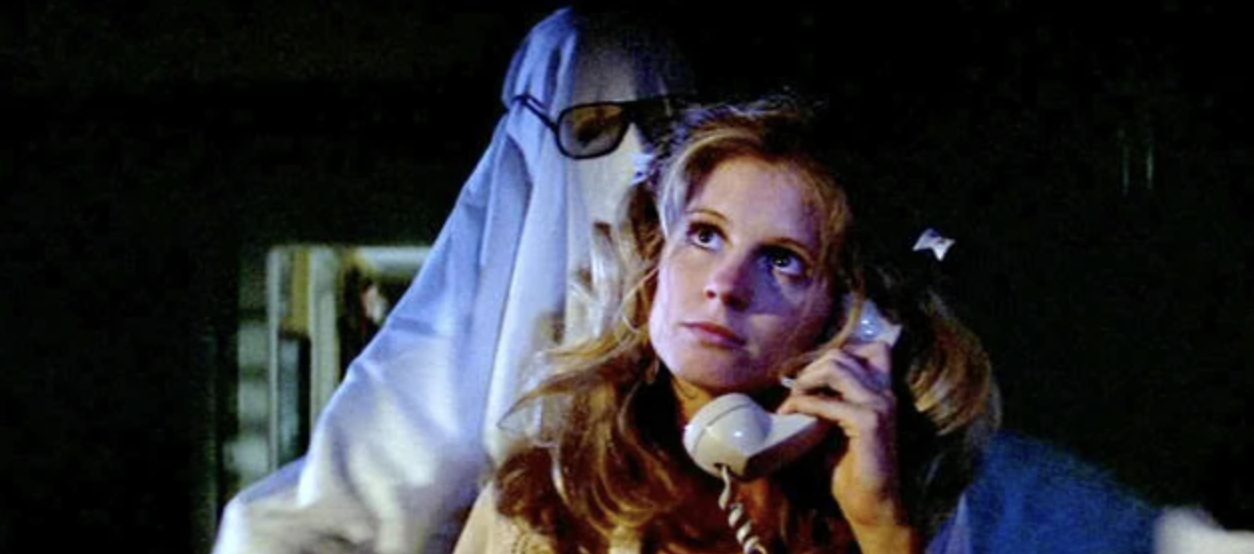
John Carpenter’s Halloween presents one of the clearest examples of this contrast through Laurie Strode and her friend Lynda van der Klok. From her introduction, Lynda is defined through flirtation, appearance, and her relationship with her boyfriend. Laurie, meanwhile, is studious, responsible, and maternal, spending the evening babysitting while her friends pursue sex and alcohol. Their opposing characterisations immediately establish the moral framework of the film.
This contrast becomes particularly explicit during Lynda’s death scene. While Laurie studies across the street, Lynda lounges in bed waiting for her boyfriend, unaware that Michael Myers has murdered him. Carpenter deliberately sexualises the scene through framing and performance, turning Lynda’s death into something voyeuristic rather than tragic. As Michael strangles her with the telephone cord, her cries are mistaken by Laurie for playful moaning. The scene transforms female suffering into spectacle, collapsing sexuality and violence into one another.
Crucially, Lynda’s death is also humiliating. Her body is later displayed with her shirt open and her corpse posed grotesquely for shock value. In death, she is denied the dignity afforded to male victims. The violence becomes not only physical but symbolic: punishment for transgressing the film’s moral expectations.
A similar dynamic emerges in Tobe Hooper’s The Texas Chain Saw Massacre. Sally Hardesty, the eventual survivor, is contrasted with Pam, whose revealing clothing and flirtatious behaviour visually separate her from the more modest Sally. Horror cinema frequently uses costume as ideological shorthand, signalling which women are “good” and which are narratively doomed long before the violence begins.
Pam’s death is especially revealing in how it is filmed. After discovering Kirk’s disappearance, she wanders into the farmhouse where Leatherface eventually hooks her body onto a meat hook. The sequence lingers on her terror and physical vulnerability, framing her body through lingering low angles and prolonged shots that eroticise her suffering. Her boyfriend dies quickly; Pam’s death, by contrast, is drawn out and sadistic. The audience is invited not merely to witness violence, but to consume it visually.
Carol Clover famously argued that audiences identify with the Final Girl because she masculinises herself through intelligence, caution, and endurance. Yet slasher films simultaneously feminise and degrade the women who fail to conform to those traits. The Fallen Girl’s sexuality becomes inseparable from the violence inflicted upon her body.
Wes Craven’s Scream complicates these conventions while still reproducing many of them. On one hand, the film openly acknowledges the “rules” of horror cinema, mocking the genre’s tendency to kill sexually active women. On the other, it still subjects characters like Tatum Riley to deeply gendered violence.
Tatum’s death scene is perhaps the clearest example. Confident, flirtatious, and sexually expressive, Tatum occupies the traditional role of the Fallen Girl despite the film’s self-awareness. Her death in the garage is filmed with exaggerated cruelty and humiliation. As Ghostface crushes her through the cat flap of the garage door, the scene fixates upon her body becoming physically trapped because of her sexualised femininity. Even in parody, the genre cannot fully escape the misogynistic structures on which it was built.
What makes these deaths particularly striking is the difference between how male and female victims are treated. Men in slasher films are often killed quickly and functionally. Women, however, are frequently eroticised before, during, and after death. Their suffering is extended, displayed, and aestheticised in ways that reinforce the connection between female sexuality and punishment.
The Final Girl trope therefore operates less as a celebration of female survival than as a conditional reward system. Women may survive horror, but only if they conform to a narrow standard of acceptable femininity. Purity becomes protection, while sexual agency invites violence.
Although contemporary horror has increasingly challenged these conventions, traces of the Fallen Girl archetype remain deeply embedded within the genre. Films like Jennifer’s Body, Raw, and Titane have begun reclaiming female sexuality from punishment narratives, allowing women to exist outside the rigid virgin-whore dichotomy that dominated earlier slashers. Yet the persistence of the Final Girl formula demonstrates how deeply horror cinema has historically relied upon patriarchal anxieties surrounding women’s bodies and behaviour.
Ultimately, slasher films reveal far more than a fear of death. They expose cultural fears surrounding female autonomy itself. Beneath the masks, knives, and bloodshed lies a genre obsessed with disciplining women who dare to step outside prescribed boundaries of femininity.